
Quick answer: There is no single grams-to-cups conversion — it depends on the ingredient’s density. One US cup of all-purpose flour weighs 120–125 grams, one cup of granulated sugar weighs 200 grams, one cup of butter weighs 227 grams, and one cup of water weighs 236.6 grams. Use the charts below, or divide grams by the ingredient’s grams-per-cup.
If you bake with recipes from different countries, you have run into this problem: American recipes measure in cups, European recipes measure in grams, and your kitchen scale only speaks one language. At Zyrro, we built this complete grams-to-cups conversion chart so you never have to guess again — with separate tables for flour, sugar, butter, liquids, and grains, plus the simple formula behind every conversion.
Table of Contents
- How Many Grams Are in a Cup?
- Grams to Cups Conversion Chart for Flour
- Grams to Cups Conversion Chart for Sugar
- Grams to Cups Conversion Chart for Butter and Oils
- Grams to Cups Conversion Chart for Liquids
- Grams to Cups Conversion Chart for Rice, Oats and Grains
- Quick Reference: 50, 100, 200 and 250 Grams to Cups
- How to Convert Grams to Cups: The Formula
- Why Can’t You Convert Grams to Cups Directly?
- Tips for Measuring Ingredients Accurately
- Frequently Asked Questions
How Many Grams Are in a Cup?
It depends entirely on what you are measuring. A cup is a unit of volume (236.588 ml in the US customary system), while a gram is a unit of weight — so the same cup holds a different weight of flour than of sugar or honey. The short version: 1 cup of all-purpose flour = 120–125 g, 1 cup of granulated sugar = 200 g, 1 cup of butter = 227 g, and 1 cup of water = 236.6 g. Everything else falls somewhere in between, which is exactly why one universal conversion number cannot exist.
This is also why professional bakers overwhelmingly prefer grams: weight does not change with how tightly you pack the cup, the humidity in your kitchen, or whether you scooped or spooned. But when a recipe only gives you one system, the charts below bridge the gap.
Grams to Cups Conversion Chart for Flour
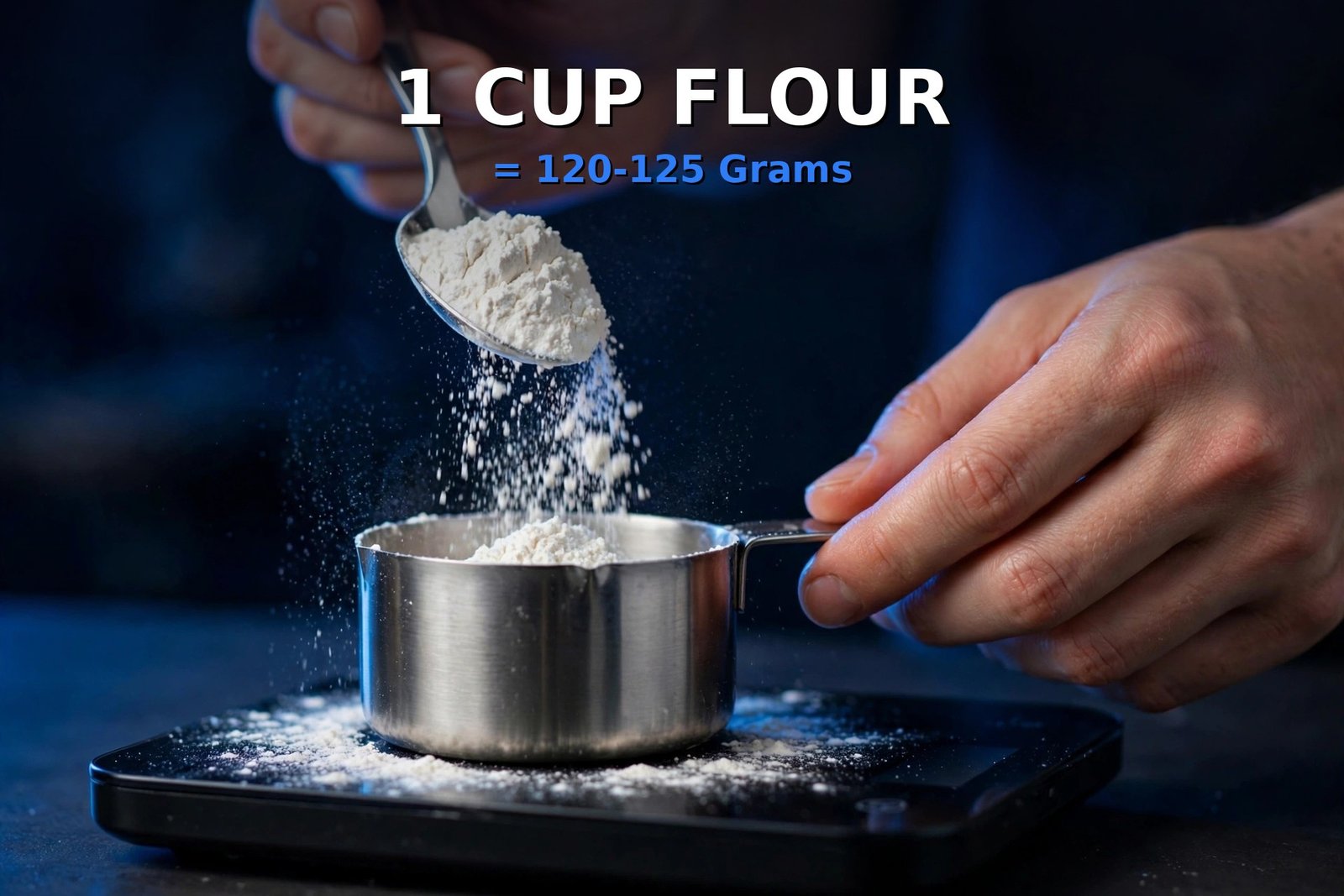
Flour is the trickiest ingredient to convert because its weight per cup changes with how you fill the cup. Spooned and leveled all-purpose flour weighs about 120–125 grams per cup (King Arthur Baking, one of the most-cited references in American baking, uses 120 g). Scooping directly from the bag can pack in 140 grams or more — a 15% error before you even start.
| Grams | Cups (all-purpose flour, 125 g/cup) | Practical measure |
|---|---|---|
| 18 g | 0.14 cup | 2 tbsp + 1 tsp (scant) |
| 32 g | 0.26 cup | ¼ cup |
| 35 g | 0.28 cup | ¼ cup + 1 tsp |
| 40 g | 0.32 cup | ⅓ cup (scant) |
| 50 g | 0.40 cup | ⅓ cup + 1 tbsp |
| 60 g | 0.48 cup | ½ cup (scant) |
| 90 g | 0.72 cup | ¾ cup (scant) |
| 100 g | 0.80 cup | ¾ cup + 1 tbsp |
| 120 g | 0.96 cup | 1 cup (King Arthur standard) |
| 125 g | 1 cup | 1 cup |
| 150 g | 1.20 cups | 1⅕ cups |
| 180 g | 1.44 cups | 1½ cups (scant) |
| 190 g | 1.52 cups | 1½ cups |
| 200 g | 1.60 cups | 1⅔ cups |
| 250 g | 2 cups | 2 cups |
| 260 g | 2.08 cups | 2 cups + 1 tbsp |
| 340 g | 2.72 cups | 2¾ cups (scant) |
| 360 g | 2.88 cups | 2⅞ cups |
| 500 g | 4 cups | 4 cups |
| 900 g | 7.20 cups | 7⅕ cups |
Other flours differ slightly: bread flour runs about 127 g per cup, cake flour about 114 g, and whole wheat about 120 g. For most home baking the all-purpose chart above is close enough.
Grams to Cups Conversion Chart for Sugar
Sugar is denser than flour, so a cup weighs considerably more. One cup of granulated sugar weighs 200 grams — one of the most-searched conversions in baking. Brown sugar is heavier still when packed (220 g per cup), while powdered sugar is much lighter (120 g per cup unsifted).
| Grams | Granulated (200 g/cup) | Brown, packed (220 g/cup) | Powdered (120 g/cup) |
|---|---|---|---|
| 50 g | ¼ cup | ¼ cup (scant) | ⅓ cup + 1 tbsp |
| 75 g | 0.38 cup (⅜ cup) | 0.34 cup (⅓ cup) | 0.63 cup (⅝ cup) |
| 80 g | 0.40 cup | 0.36 cup | 0.67 cup (⅔ cup) |
| 100 g | ½ cup | 0.45 cup | 0.83 cup (¾ + 1 tbsp) |
| 125 g | 0.63 cup (⅝ cup) | 0.57 cup | 1.04 cups |
| 150 g | ¾ cup | 0.68 cup (⅔ cup) | 1¼ cups |
| 180 g | 0.90 cup | 0.82 cup | 1.50 cups |
| 200 g | 1 cup | 0.91 cup | 1⅔ cups |
| 220 g | 1.10 cups | 1 cup | 1.83 cups |
| 250 g | 1¼ cups | 1.14 cups | 2 cups + 1 tbsp |
| 300 g | 1.50 cups | 1.36 cups | 2.50 cups |
| 400 g | 2 cups | 1.82 cups | 3⅓ cups |
Note on brown sugar: American recipes almost always mean packed brown sugar — pressed firmly into the cup. Loosely filled, a cup of brown sugar can weigh 10–15% less, which is why the “packed” distinction matters for cookies and caramel sauces.
Grams to Cups Conversion Chart for Butter and Oils
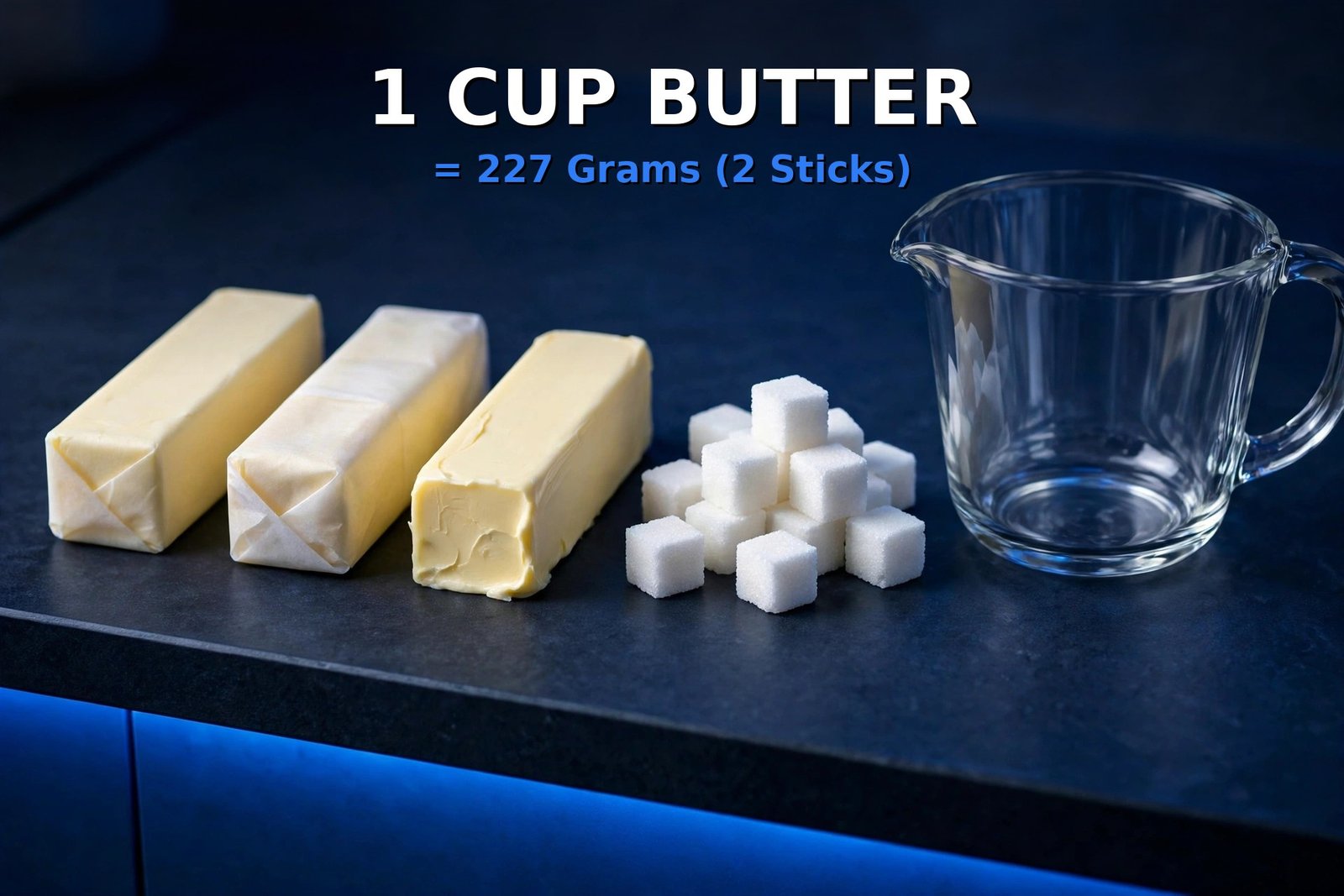
One cup of butter weighs 227 grams — exactly 2 US sticks, or 8 ounces. This is one of the few conversions that is effectively exact, because butter is sold in standardized sticks (each 113 g, or ½ cup). Oils are a little lighter per cup since fat is less dense than water.
| Grams | Butter (227 g/cup) | Vegetable oil (218 g/cup) |
|---|---|---|
| 50 g | 0.22 cup (3½ tbsp) | 0.23 cup |
| 100 g | 0.44 cup (7 tbsp) | 0.46 cup |
| 113 g | ½ cup (1 stick) | 0.52 cup |
| 200 g | 0.88 cup | 0.92 cup |
| 227 g | 1 cup (2 sticks) | 1.04 cups |
| 250 g | 1.10 cups (1 cup + 2 tbsp) | 1.15 cups |
European butter blocks are often sold in 250 g wrappers — that is 1.10 cups, or 1 cup plus 2 tablespoons. If a US recipe calls for 2 sticks and you have a 250 g block, cut off roughly 23 g (about 1½ tablespoons) for an exact match.
Grams to Cups Conversion Chart for Liquids
Liquids are the simplest case: for water, grams and milliliters are identical (1 ml of water weighs exactly 1 g), so 1 cup of water weighs 236.6 grams. Milk is marginally heavier at about 245 g per cup. If you also work with volume-to-volume conversions, see our cups to mL conversion chart for the full US, UK and metric cup breakdown.
| Grams | Water (236.6 g/cup) | Milk (245 g/cup) | Honey (340 g/cup) |
|---|---|---|---|
| 100 g | 0.42 cup | 0.41 cup | 0.29 cup (⅓ cup scant) |
| 200 g | 0.85 cup | 0.82 cup | 0.59 cup |
| 250 g | 1.06 cups | 1.02 cups | 0.74 cup (¾ cup) |
| 340 g | 1.44 cups | 1.39 cups | 1 cup |
| 500 g | 2.11 cups | 2.04 cups | 1.47 cups |
Honey deserves a callout: a cup of honey weighs 340 grams, nearly 1.5 times a cup of water. Maple syrup runs about 315 g per cup and molasses about 328 g.
Grams to Cups Conversion Chart for Rice, Oats and Grains
Grains vary widely because of their shape and how they settle. One cup of uncooked long-grain white rice weighs about 185 grams, while rolled oats are much lighter at roughly 90 grams per cup.
| Grams | White rice, uncooked (185 g/cup) | Rolled oats (90 g/cup) |
|---|---|---|
| 50 g | 0.27 cup (¼ cup) | 0.56 cup (½ cup + 1 tbsp) |
| 90 g | 0.49 cup (½ cup) | 1 cup |
| 100 g | 0.54 cup (½ cup + 1 tbsp) | 1.11 cups |
| 185 g | 1 cup | 2.06 cups |
| 200 g | 1.08 cups | 2.22 cups |
Brown rice is slightly heavier (about 195 g per cup uncooked), and quick oats pack a little denser than old-fashioned rolled oats. For porridge and overnight oats, the oats column above is the one most people search for.
Quick Reference: 50, 100, 200 and 250 Grams to Cups
The four amounts below cover the vast majority of “grams to cups” searches. Find your ingredient’s row, read across to your amount:
| Ingredient (1 cup =) | 50 g | 100 g | 200 g | 250 g |
|---|---|---|---|---|
| All-purpose flour (125 g) | 0.40 cup | 0.80 cup | 1.60 cups | 2 cups |
| Granulated sugar (200 g) | ¼ cup | ½ cup | 1 cup | 1¼ cups |
| Butter (227 g) | 0.22 cup | 0.44 cup | 0.88 cup | 1.10 cups |
| Water (236.6 g) | 0.21 cup | 0.42 cup | 0.85 cup | 1.06 cups |
| Honey (340 g) | 0.15 cup | 0.29 cup | 0.59 cup | 0.74 cup |
| White rice, uncooked (185 g) | 0.27 cup | 0.54 cup | 1.08 cups | 1.35 cups |
| Rolled oats (90 g) | 0.56 cup | 1.11 cups | 2.22 cups | 2.78 cups |
How to Convert Grams to Cups: The Formula
Every number in the charts above comes from one simple formula: cups = grams ÷ grams-per-cup for that ingredient. For example, 200 grams of all-purpose flour is 200 ÷ 125 = 1.6 cups. Here is the three-step method:
- Find your ingredient’s grams-per-cup. Use the tables above, or a reference like King Arthur Baking’s ingredient weight chart.
- Divide your grams by that number. 300 g of granulated sugar ÷ 200 = 1.5 cups.
- Round to a measurable amount. Convert the decimal to the nearest tablespoon (1 cup = 16 tbsp): 0.1 cup ≈ 1½ tbsp.
The full physics version: cups = grams ÷ (density in g/ml × 236.588), since one US cup holds 236.588 ml. For water (density 1.0), that gives 236.6 g per cup — matching the chart. If you convert measurements often, skip the mental math and use our free unit converter tool, which handles weight, volume, and cooking units instantly.
Why Can’t You Convert Grams to Cups Directly?
Because they measure different physical properties. Grams measure mass; cups measure volume. The bridge between them is density — how much mass fits in a given volume — and density is a property of the ingredient, not of the units. A cup of lead and a cup of feathers are both one cup, but their gram weights are wildly different; flour and honey work the same way on a smaller scale.
This is also why “1 cup = 250 grams” (a shortcut you will see online) is wrong as a general rule. It only holds for water-like liquids — for flour it overstates by 100%, the most common cause of dense, dry cakes in converted recipes.
Tips for Measuring Ingredients Accurately
- Buy a kitchen scale. A basic digital scale costs less than a bag of specialty flour and eliminates conversion error entirely. Weighing is what professional bakeries do, and it is the single biggest upgrade to your baking accuracy.
- Spoon and level flour — never scoop. Scooping with the measuring cup compacts flour and can add 15–20 grams per cup. Spoon flour into the cup, then level the top with a straight knife.
- Pack brown sugar, sift powdered sugar. Brown sugar should be pressed firmly into the cup until it holds its shape; powdered sugar should be sifted or at least fluffed, since it compacts in the bag.
- Measure sticky ingredients with oiled cups. Lightly coat the cup with oil before measuring honey or molasses — it slides out cleanly.
- Know which cup your recipe means. A US cup is 236.588 ml, but a metric cup is 250 ml and an old UK cup is 284 ml. Most modern recipes mean US cups, but check — a 5% systematic error across every ingredient adds up.
Frequently Asked Questions
How many grams are in a cup of flour?
One US cup of spooned-and-leveled all-purpose flour weighs 120–125 grams. King Arthur Baking, the most-cited American reference, uses 120 g per cup; many other charts use 125 g. The difference is about 4% — negligible. What matters more is technique: scooping flour straight from the bag can pack in 140 grams or more per cup.
How do I convert grams to cups without a kitchen scale?
Use an ingredient-specific conversion chart like the ones above — never a single universal number. Find your ingredient, find your gram amount, and read across to cups. For the most common cases, remember three anchors: flour 125 g per cup, sugar 200 g per cup, butter 227 g per cup.
Is 250 grams the same as 1 cup?
No — only for ingredients that weigh about 237 grams per cup, like water (236.6 g). For everything else it differs: 250 g of all-purpose flour is 2 cups, 250 g of granulated sugar is 1¼ cups, and 250 g of butter is about 1.1 cups. The “250 g = 1 cup” shortcut only works for water-like liquids.
Why do American recipes use cups while European recipes use grams?
It is a historical split: US home cooking standardized on volume measures (cups, tablespoons) in the late 1800s, while metric countries standardized on weight. Grams are objectively more accurate — a gram is a gram anywhere — which is why professional bakers worldwide, including in the US, formulate recipes by weight. Converting between the systems requires knowing each ingredient’s density.
Can I use an online calculator instead of a conversion chart?
Yes — a calculator is faster for odd amounts the chart does not list, like 175 grams of flour. Zyrro’s free unit converter converts between grams, cups, ounces, tablespoons, and milliliters instantly, right in your browser. Charts are better for learning the common anchors; calculators win for everything else.
How many cups is 1 gram?
Practically none — 1 gram of flour is about 0.01 cup (less than half a teaspoon) and 1 gram of sugar is about 0.005 cup. Tiny amounts like 1 g or 3 g (about 0.02 cup of flour, roughly 1 teaspoon) are too small to measure in cups; weigh them on a kitchen scale instead.
Convert Any Amount Instantly With Zyrro’s Free Tool
Charts cover the common cases, but recipes rarely use round numbers. For anything not listed above — 175 grams of flour, 60 grams of cocoa, 2.5 cups to grams in reverse — use Zyrro’s free unit converter: pick your ingredient type, enter the amount, and get the answer instantly. It runs entirely in your browser, covers weight, volume, temperature, and cooking units, and there is nothing to install.
Accurate conversions are a small habit with an outsized payoff. Whether you are adapting a European sourdough recipe or scaling up a birthday cake, measuring by weight — or converting to cups correctly — is what separates consistent results from kitchen roulette.